Computer Systems Design And Architecture 2nd Edition Free Download
The Encyclopedia of Human-Calculator Interaction, 2nd Ed.
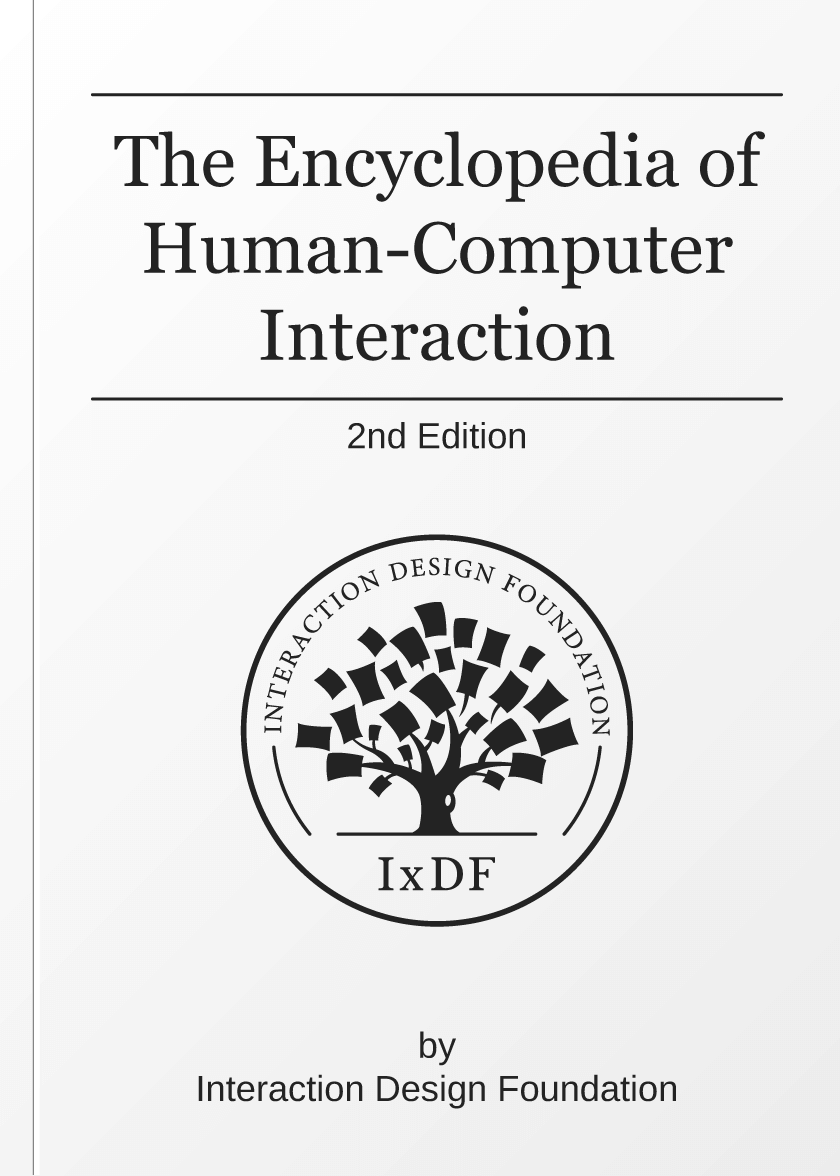
Gratis textbooks written by more than than 100 leading designers, bestselling authors, and Ivy League professors. We have assembled our textbooks in a gigantic encyclopedia, whose 4,000+ pages cover the design of interactive products and services such every bit websites, household objects, smartphones, figurer software, shipping cockpits, and what have you. Name an item of blueprint interest, and you'll probably find it discussed within.
Authors
Adnan Ahmad was born in Lahore, Pakistan. He received his Bachelor of Science (Hons.) from Govt. College University (GCU, 2005), with a major in software engineering, and a Masters of Science from Lahore Academy of Management Sciences (LUMS, 2009), with a major in distributed systems. He worked for five years in industry, getting hands on experience with cutting border software and hardware technologies. His PhD in Information Technology at Massey University, New Zealand, was on a formal model of distributed rights allocation in online social interaction. He has published in well-known conferences like Worldcomp, IFIP SEC, IAS, IAIT and Trustcom. His current research applies socio-technical design principles to reckoner security, and his other interests include oversupply sourcing, distributed systems, spam and paradigm processing.
I only have one big inquiry question, but I attack it from a lot of different angles. The question is representation. How do people brand, come across and use things that carry pregnant? The angles from which I attack my question include diverse ways in which representations are applied (including design processes, interacting with technology, computer programming, visualisation), various methods by which I collect research data (including controlled experiments, prototype structure, ethnographic observation), and the theoretical perspectives of various bookish disciplines (including information science, cognitive psychology, engineering science, architecture, music, anthropology). If you are based in Cambridge, you may like to attend the following talks on man-computer interaction. This page lists a few big inquiry themes and major projects illustrating them. Smaller projects, including contributions to enquiry communities and inquiry-related teaching, are described on my publications page, and other activities folio. Crucible: Research in Interdisciplinary Pattern Crucible is the Cambridge network for research in interdisciplinary pattern, which I founded with David Expert. The network encompasses very many projects, funding sources and collaborators. Crucible projects include applied blueprint work (as commercial consultants or in academic contexts) that draws on multiple disciplinary perspectives. We likewise deport out a significant amount of design research - investigating the processes of design piece of work, developing facilitation processes for blueprint activeness, informing public policy related to the design of public value from academic research, and creating new and experimental software tools for designers to use. Many of these projects draw on my core expertise in visual representation. Software and Creativity Many contemporary arts practitioners develop software, incorporate it into their work, or utilise software tools to extend their professional person practice. This inquiry theme involves collaboration with a wide range of artists, including many with international profiles, exploring the means in which they utilise representations. We take created a broad range of new software tools and programming languages for composers, performers, choreographers, sculptors and others. Many of these projects are linked via the Crucible page. Social Media and Activism Internet engineering research is crucially dependent on understanding the social dynamics of the ways in which information technology is used, and collaboration with social scientists is essential to provide intellectual rigor and new insights. These projects have investigated the design and deployment of new social media, both in the world at large (various professional person and political contexts), and within the Academy itself. In all cases, the representation of social relations around and within technical systems has been disquisitional to understanding and the development of new understanding among all stakeholders. Many of these projects are linked via the Crucible page. Energy Monitoring and Usage Electricity is invisible, so our awareness of environmental impacts arising from energy use is solely dependent on the quality of the visual representations provided of energy use. Ever since contributing to the blueprint of the beginning generation of semi-smart domestic gas meters in 1991, I have taken an interest in the user interface of domicile free energy controls and monitoring. Several of our projects are concerned with helping people understand and control the patterns of energy usage in their homes. Many of these projects are linked via the Crucible page. PhD Students' Research Michal Kosinski - psychological instruments for the assessment of business value in social networking technologies. Mo Syed - blueprint techniques for incorporating social factors in technology development. Luke Church building - social, cognitive, philosophical, artistic and technical perspectives on the manipulation of data. Chris Nash - Supporting Virtuosity and Flow in Computer Music. Cecily Morrison - Bodies-in-Space: investigating technology usage in co-present grouping interaction (thesis). Now a Enquiry Associate in the Cambridge Engineering Design Centre. Lorisa Dubuc - Design research to assist conversation in dementia. Darren Edge - Tangible user interfaces for peripheral interaction (thesis). At present at Microsoft Research Asia, Beijing. Nick Collins - Autonomous Agents for Live Computer Music (co-supervised with Ian Cross) (thesis). Now a lecturer in Computer Music at the University of Sussex. Martyn Dade-Robertson - the application of architectural design principles to the design of software navigation (co-supervised with Francois Penz and Maureen Thomas). Now a lecturer in Architecture and Communication at Newcastle University Older projects (some sites no longer maintained) AutoHAN: Control Interfaces for Home Automation In Autohan we were trying to solve the bones problems of home control, where a multitude of devices must interact with each other and the residents in a sensible manner. Ane output was the tangible programming language "Media Cubes". EUSES: Stop-Users Shaping Effective Software The EUSES Consortium is an NSF-funded collaboration with researchers at Oregon State Academy, Carnegie Mellon University, Drexel University, Penn State Academy, and the University of Nebraska whose goal is to develop and investigate technologies for enabling Cease Users to Shape Effective Software. Vital Signs: New Paradigms for Visual Interaction EPSRC funded project, now consummate, investigating notations, abstraction, representation and interaction in a metaphor-costless theoretical framework. Cognitive Dimensions of Notations Long-term dissemination and archival of cloth related to the Cognitive Dimensions of Notations usability framework, including publishing and professional pedagogy projects. Dasher Collaboration with the Cavendish Laboratory Inference Group - Dasher is a information entry interface incorporating language modelling and driven by continuous ii-dimensional gestures. More general implications are in how we tin collaborate with adaptive "intelligent" interfaces. Webkit: Intuitive Physical Interface to the Web European-funded inquiry project, now consummate (and various partners disappeared) designing tangible user interfaces that can be used in classrooms to access the spider web, control query engines, and stucture give-and-take. EUDNET: Network of Excellence in End-User Development
I am a computing professor at Lancaster University and researcher at Talis Ltd. and piece of work on most things that connect people and computers. Even so, I started off (years ago) as mathematician and this is still my academic get-go love!
I am a professor at the University of Stuttgart. My central research interests are novel user interfaces and innovative applications enabled by ubiquitous calculating. Before moving to Stuttgart I was a professor at the Univeristy of Duisburg-Essen, had a joined position betwixt the Fraunhofer Constitute for Intelligent Analysis and Information Systems (IAIS) and the University of Bonn. I studied computer science in Ulm and Manchester and afterwards worked as a researcher at the University of Karlsruhe and at Lancaster University. There I completed in 2003 my PhD thesis on the topic of "Ubiquitous Calculating - Computing in Context". Earlier I became professor at the B-IT-Centre I headed the DFG-funded "Embedded Interaction Research Group" at the Ludwig-Maximilians University in Munich. My teaching and research interests are in media informatics and in particular in the areas of user interface engineering, pervasive calculating and mobile interactive systems.
Alistair Sutcliffe (MA Cantab-Natural Sciences, PhD Wales) is Professor of Systems Applied science, and Director of the Centre for HCI Design, in the School of Information science, University of Manchester, U.k.. Originally at ethologist, he has worked in the Information technology and finance manufacture, the civil service and City and Manchester Universities. His inquiry spans software applied science, human computer interaction, cognitive and social science, with recent interests in scenario based design, methods for requirements engineering, analysis and modelling circuitous socio technical systems, visualisation and creative blueprint . He is a leading authorization on homo factors in safe critical systems, requirements applied science and multimedia user interface blueprint, has authored 6 books and 200+ publications on human computer interaction, requirements engineering, software and domain knowledge reuse. His recent books include: Multimedia and virtual reality: Designing multisensory user interfaces. Lawrence Erlbaum Associates (2003) User-Centred Requirements Engineering science. Springer, (2002) and The Domain Theory: Patterns for knowledge and software reuse, Lawrence Erlbaum Assembly (2002). He currently manages EPSRC projects ADVISES (E-scientific discipline requirements analysis and visualisation) and ESRC/EPSRC Foresight projection Developing Theory for Evolving Socio Technical Systems and was recently PI of EPSRC projects SIMP- Systems Integration for Major Projects, ISRE Immersive scenario based Requirements Technology and CORK Corporate Knowledge Repository. He serves on the editorial boards of several journals in the software engineering science and human computer interaction. He founded IFIP TC-13 Working Group thirteen.2 Methodology for User Centred Design, is editor of the ISO standard 14915, on Multimedia user interface design, co-chaired the ACM conference Designing Interactive Systems 2002 and is co-chair of IEEE Requirements Engineering conference in 2007. He was awarded the IFIP silver core in 1999, is a reviewer for EPSRC college, INRIA cognitive engineering projects 2002 & 2006, NSF Science of Design program and made recent plenary keynote presentations at IHM03, HCI05, and CAiSE06 conferences
A sociologist past background, Andy started working with computer scientists and software engineers when he did his PhD with John Hughes at Lancaster. John pioneered the use of ethnography in systems design and Andy has been working on shaping computing around the social for the all-time part of 20 years now. He has published widely, including a couple of textbooks on ethnography for design. He was awarded an RCUK Academic Fellowship in 2006, which solidified his piece of work at Nottingham in the Mixed Reality Laboratory, an interdisciplinary inquiry group with an international reputation for innovative work at the interface between computing and society.
Ann Blandford is Professor of Homo-Computer Interaction in the Department of Informatics at University College London and served equally Director of UCL Interaction Centre (UCLIC) (2004-2011). Her teaching includes User-Centred Evaluation Methods on the MSc in HCI with Ergonomics at UCL. She started her career in industry, as a software engineer, but soon moved into academia, where she adult a focus on the use and usability of computer systems. Ann leads research projects on human error and on interacting with data, with a focus on modeling situated interactions. In particular, she leads an EPSRC Platform Grant on Interactive Systems in Healthcare, and an EPSRC Programme Grant, CHI+MED, on Man-Computer Interaction for Medical Devices. She has been technical program chair for several conferences, the most recent being NordiCHI 2010. Run across http://www.ucl.ac.united kingdom/uclic/people/a_blandford/ for more detail.
Ben Challis is a composer, performer and technologist. With research interests that embrace the notion of blueprint-for-all within music-performance, he has worked on various projects that explore alternative modes of interaction with audio and music for people with specific individual needs. As a performer, he works with these same technologies, exploring their creative and expressive potential within free-improvisation. Equally composer he has composed scores for motion picture and theatre productions. He is a Senior Lecturer and Joint Award Leader in Pop Music at the University of Glamorgan, ATRiuM.
Born in England and brought upwards in New Zealand, Brian Whitworth currently works at Massey University in Auckland, New Zealand. After doing a mathematics degree, and a Master'due south thesis on split-brain neuropsychology, Brian joined the New Zealand Army, where he was the outset specialist to consummate ground forces officeholder cadet preparation. He worked every bit an army psychologist, and then in reckoner operational simulations (wargames), while simultaneously raising four wonderful children, until he retired in 1989 as a Major. Brian then completed his doctorate on online groups, and students at his university used the social voting system he congenital until the World Wide Web arrived. In 1999, he worked in the U.s.a. as a professor, and published in journals like Small-scale Grouping Research, Group Decision and Negotiation, Communications of the AIS, IEEE Estimator, Behavior and It, and Communications of the ACM. More recently, he was the senior editor of the Handbook of Research on Socio-Technical Pattern and Social Networking Systems, written by over a hundred leading experts worldwide. His interests include computing, psychology, quantum theory and motor-bike riding.
Caroline Hummels is a professor of Design and Theory for Transformative Qualities at the department of Industrial Design at the Eindhoven University of Applied science (TU/e). Her activities concentrate on designing and researching transforming practices. With her team and external stakeholders, including the Provence of North-Brabant, Philips Design, RISE, Rijkswaterstaat, Enpuls, and ZET, she leverages emerging technologies through which they jointly change practices to navigate transforming societies towards sustainable futures. Doing so, she focuses on being-in-the-earth theories, embodied and aesthetics interactions, imagination, data-enabled design, and participatory sensemaking. She researches and questions transforming practices and societies through theoretical lenses, including design-philosophy correspondence, in which philosophy informs pattern practice, and blueprint exercise is used to philosophize, in social club to tackle imminent societal challenges. Caroline is founder and member of the steering committee of the Tangible Embedded, and Embodied Interaction (TEI) Briefing, editorial board fellow member of the International Periodical of Design, member of the Dutch Pattern Week sounding lath, and administrator of CLIKCNL for the Key Enabling Methodologies related to 'Participation and co-cosmos. Moreover, she has given a large number of keynote speeches, invited lectures and workshops at conferences, international universities, and for industry and governmental institutes worldwide.
Christopher Scaffidi is currently an Assistant Professor of Figurer Scientific discipline in the Schoolhouse of EECS at Oregon State Academy. His inquiry interests are where human-computer interaction and software engineering intersect. Nearly of his current projects aim to help software users to create code for themselves, and to effectively share that code with ane another. He is presently serving as Director of the EUSES Consortium, an international association of seven universities and one company. He was Co-chair for the Poster/Work-in-progress runway at the 2009 International Symposium on End-User Development and is on the programme committee for the 2010 ACM SIGCHI Symposium on Applied science Interactive Computing Systems. He is a member of the ACM and IEEE.
Clarisse Sieckenius de Souza is Full Professor of Computer Science at the Departamento de Informática, PUC-Rio, where she has likewise served as the director of the Graduate Studies Program for 2 terms (2003-2005 and 2007-2009). In 2010, Clarisse was a co-winner of the prestigious ACM SIGDOC Rigo Award (see pictures and more on SERG Website).In 1996 she founded SERG (the Semiotic Engineering Inquiry Grouping). Amongst the xv Grand.Sc. and 19 Ph.D. students that she has (co-)supervised, more than half are kinesthesia in various Brazilian universities and nearly one-third piece of work in the industry.In 2005 she published her showtime book, The Semiotic Applied science of Human-Computer Interaction (The MIT Printing). Her 2nd book, Semiotic Engineering science Methods for Scientific Research in HCI, co-authored past Carla Leitão, was published in 2009, in Morgan & Claypool's Synthesis Lectures Series.
Clayton M. Christensen was a professor at Harvard Business Schoolhouse and a New York Times bestseller. He was the architect of, and the world's foremost authority on, disruptive innovation. Consistently best-selling in rankings and surveys every bit i of the world's leading thinkers on innovation, his research has been applied to national economies, first-up and Fortune fifty companies, equally well as to early and late-stage investing. His seminal book The Innovator's Dilemma (1997), which start outlined his disruptive innovation frameworks, received the Global Concern Book Award for the Best Business Book of the Year in 1997, was a New York Times bestseller, has been translated into over 10 languages, and is sold in over 25 countries. He was also a four-time recipient of the McKinsey Honour for the Harvard Business organisation Reviews's all-time article and received a Lifetime Achievement Award from the Tribeca Pic Festival in 2010. Christensen had focused his innovation lens on two of our almost vexing social problems, education and health intendance. Disrupting Class which looks at the root causes of why schools struggle and offers solutions was named one of the "ten Best Innovation and Design Books in 2008" by BusinessWeek and the best Human Capital letter volume of the yr in the Strategy + Business concern Best Books of 2008. The Innovator'southward Prescription (2009) examines how to gear up the problems facing healthcare. So as to further examine and utilise his frameworks to the social sector, Christensen founded Innosight Institute, a non-profit remember tank, in 2008. An advisor to numerous countries and companies, including the regime of Singapore, he was a board fellow member at Republic of india's Tata Consultancy Services (NYSE: TCS), Franklin Covey (NYSE: FC), Westward.R. Hambrecht, and Vanu. Christensen likewise applies his frameworks via management consultancy Innosight which he co-founded in 2000, and Rose Park Advisors, an investment firm he founded in 2007. Christensen was built-in in Table salt Lake City, Utah in 1952. He graduated with highest honors in economic science from Brigham Young University in 1975. Later, he received an 1000.Phil. in applied econometrics and the economics of less-developed countries from Oxford University in 1977, where he studied every bit a Rhodes Scholar. He received an MBA with High Distinction from the Harvard Business School in 1979, graduating as a George F. Baker Scholar. In 1982-1983 he was a White House beau, serving equally an assistant to U.S. Transportation Secretaries Drew Lewis and Elizabeth Dole. In 1992, he was awarded a DBA from the Harvard Business organization School, receiving the All-time Dissertation Award from the Institute of Management Sciences for his doctoral thesis on engineering science development in the disk drive industry. He was the Robert and Jane Cizik Professor of Business concern Assistants at the Harvard Business concern School. Professor Christensen was committed to both community and church. In addition to his stint as a White House Fellow, he was an elected member of the Belmont Town Council for 8 years, and has served the Boy Scouts of America for 25 years as a scoutmaster, cub master, den leader and troop and pack commission chairman. He likewise worked as a missionary for the Church of Jesus Christ of Latter-day Saints in the Commonwealth of Korea from 1971 to 1973, spoke fluent Korean, and was a leader in his church building. He and his married woman Christine lived in Belmont, MA, and their family includes 5 children and three grandchildren.
Constantine Stephanidis, Professor at the Department of Figurer Scientific discipline of the University of Crete, is the Director of the Institute of Information science, Foundation for Research and Technology - Hellas, Caput of the Human - Computer Interaction Laboratory, and of the Eye for Universal Access and Assistive Technologies, and Head of the Ambience Intelligence Plan of ICS-FORTH. Over the past 25 years, Prof. Stephanidis has been engaged as the Scientific Responsible in more than 40 National and European Commission funded projects in the fields of Homo-Computer Interaction, Universal Admission and Assistive Technologies. In the beginning of the '90s he introduced the concept and principles of Design for All in Human-Machine Interaction and for Universal Access in the evolving Information Society. He has published more than than 550 technical papers in scientific archival journals, proceedings of international conferences and workshops related to his fields of expertise. He is the Editor-in-Chief of the Springer international journal "Universal Access in the Information Guild". He is the Editor and (co-)writer of xiv out of the xxx chapters of the book " User Interfaces for All - concepts, methods and tools" published by Lawrence Erlbaum Associates (2001). He is besides Editor and (co-)author of many chapters of "The Universal Admission Handbook" that was published in June 2009 by CRC Press Taylor & Francis Group. During the menstruum 1995 - 2006, he was the Founding Chair of the ERCIM Working Group "User Interfaces for All" and Full general Chair of its 9 international Workshops. During the menstruation 1997 - 2000, he was the Founding Chair of the International Scientific Forum "Towards an Information Order for All", in the context of which he edited White Papers concerning the roadmap and R&D calendar towards an Data Club for All. Since 2001 he is the Founding Chair of the International Conference "Universal Access in Human - Reckoner Interaction". Since 2007 he is the General Chair of the HCI International Conference, that takes place every two years with effectually ii,000 participants.
Dag Svanaes is a professor at the Department of Computer and Informatics at the Norwegian Academy of Scientific discipline and Technology. Svanaes is as well offshoot professor at the It-University of Copenhagen, Denmark He has been teaching and doing research in Human being-Computer Interaction (HCI) since the late 1980s. His master areas of interest are mobile and ubiquitous calculating, usability evaluation methodology, user-centered design, and the philosophy of interaction. He is currently involved in a national research initiative on medical informatics (NSEP), and take built up a usability lab for wellness ICT at NSEP.
Dave Randall was Principal Lecturer at Manchester Metropolitan University, United kingdom. until his retirement in 2011. He sorely misses his administrative load. He continues to piece of work, collaborating with people like his co-author on this piece; with Richard Harper at Microsoft Research where they are currently involved in writing a book on Pick, and with Volker Wulf at the University of Siegen in Germany. His piece of work sits primarily in the interdisciplinary research area called Computer Supported Cooperative Work (CSCW)and in HCI. He is particularly interested in the application of the ethnomethodological 'studies of work' programme to problems of new technology and organizational change, and in the conduct of ethnographic enquiry in relation to these bug. He has conducted a number of studies of 'piece of work in organizations' in his career. These include a well-known and extensively-cited written report of Air Traffic Control every bit well equally studies of retail financial services, museum piece of work, classroom interaction with new technology, ontology-based design, mobile phone utilise, and 'smart home' technology. He has undertaken consultancy and other work with organizations such as the Riso national laboratory, Kingdom of denmark; Xerox plc; the Children'south Gild; Orange plc; Vodaphone plc; Microsoft plc and the national Heart for East-Social Science (NCess) and has collaborated with partners in a number of other institutions in the United kingdom of great britain and northern ireland and Europe over a period of time. These include Lancaster University; Manchester University; the Blekinge Institue of technology and Lulea Technical University in Sweden, and the I.T. University of Denmark. He has co-authored 3 books, one an exam of organizational change and new engineering science in the retail financial services sector and another (with Mark Rouncefield and Richard Harper) on the conduct of ethnography for blueprint-related purposes. A tertiary is as well, oddly enough, co-authored with Marking Rouncefield (and others): 'Technologies of Leadership in F.E.'. He also has one edited book with 2 more on the way.Currently (2013), he is working on a report for the Economic and Social Research Council on virtual learning environments and with Hitachi Ltd in japan on the applicability of 'patterns' to engineering maintenance work.
Professor Derek McAuley is a Professor of Digital Economy in the School of Computer science and Managing director of Horizon at the University of Nottingham. After his PhD and lectureship in the Estimator Laboratory at the University of Cambridge he moved to a chair in Section of Informatics at the University of Glasgow. He returned to Cambridge in July 1997, to aid found the Cambridge Microsoft Research facility, moving on to found the Intel lablet in Cambridge in July 2002. He has worked for Intel from Baronial 2005 until August 2006.founded two startups, XenSource (now Citrix) and Netronome. He also Chief Innovation Officer (in residence) at the Digital Catapult during its startup phase in 2013/2014.
Dr. Dianne Cyr is a Professor in the Beedie School of Business at Simon Fraser University in Vancouver. She is the author of 4 books and over 100 inquiry articles, book capacity, or proceedings. Dr. Cyr has received numerous awards including All-time paper for 2009 in the superlative-ranked MISQ journal. Her groundwork is varied and interdisciplinary. Both their Bachelor's and Masters'south degrees are in Psychology, and she worked in clinical psychology for the ameliorate function of a decade before returning to academy to commence on doctoral studies. The earlier training held her in practiced stead for my Ph.D. enquiry which was focused on the linkage of strategy and human being resource management in international articulation ventures. She is currently at Simon Fraser University equally a Full Professor with tenure in Management Information Systems. Since 1994 her primary function has been equally a academy professor, coupled with activities in the business concern world. She joined Simon Fraser University (SFU) in 1994 as an Offshoot Professor, and carried a very full didactics load (of upwardly to eight courses in some years), while at the same time conducting research, publishing, and organizing a consulting exercise. An opportunity arose for full-fourth dimension academic employment at the start-up Technical University of British Columbia (TechBC) in 1998. Equally ane of the founding kinesthesia, she was involved in numerous activities to shape the mission, curriculum and structures for TechBC. More specifically, she adult the Management and Technology program until the closure of the university in 2002. At this time, TechBC was merged into SFU, and another academic affiliate began. As the President of Global Alliance Management (1993-2004), she provided consulting and preparation services in the surface area of joint ventures and strategic alliances to modest and mid-sized companies. During this time she made numerous public presentations on the topic of joint ventures or alliances and developed a program in alliances for the British Columbia Trade Development Corporation. Equally a Director of Canada Sri Lanka Upper-case letter Corporation (1994-2003), she was involved in the development of an agro-industrial joint venture in Sri Lanka.
Doug A. Bowman is a Professor of Computer science and Director of the Middle for Human-Computer Interaction at Virginia Tech. He is the principal investigator of the 3D Interaction Group, focusing on the topics of three-dimensional user interface design and the benefits of immersion in virtual environments. Dr. Bowman was the pb author of 3D User Interfaces: Theory and Practice, and served as the full general chair of the IEEE Virtual Reality Briefing in 2007-2008. He received a CAREER accolade from the National Scientific discipline Foundation for his piece of work on 3D Interaction, and has been named an ACM Distinguished Scientist. His undergraduate degree in mathematics and calculator science is from Emory University, and he received his Grand.S. and Ph.D. in information science from the Georgia Institute of Engineering.
Elisa Giaccardi is a Full Professor at Delft University of Technology, where she leads the Connected Everyday Lab. From pioneering endeavors in meta-design and social media to the role of the non-human in the Cyberspace of Things, her enquiry work reflects an ongoing business with blueprint as a shared process of the invention of reality. Her enquiry team at the Connected Everyday Lab focuses on exploring the futurity of blueprint in the emerging landscape of information technologies and bogus intelligence via Research through Pattern.
I am a Professor of Technological Innovation in the MIT Sloan School of Management, and am also a Professor in MIT'southward Engineering Systems Division. I specialize in research related to the nature and economics of distributed and open up innovation. I besides develop and teach about practical methods that individuals, open user communities, and firms can employ to improve their production and service development processes.
Fabio Paternò is Inquiry Director at C.Due north.R.-ISTI in Pisa where he founded and leads the Laboratory on Man Interfaces in Information Systems. He developed the ConcurTaskTrees notation for specifying task models and has also designed an associated environs (CTTE) to support the evolution and analysis of task models specified through this notation, which has been used in various industries and universities. The tool has been applied in several application domains (including ERP, interactive safety-disquisitional systems). He has likewise been working on the design of tools to support designers of multi-device, multi-modal interactive applications starting with user interface logical descriptions, such as MultiModal TERESA and MARIAE Such tools are associated with XML-based languages for user interface logical descriptions. He has also been working on methods and automatic back up for usability evaluation. This work has produced a number of tools that perform their intelligent analyses of client-side logs of user sessions, detected in both stationary and mobile devices. He likewise turned his attention to how to integrate usability and accessibility issues, a research area for which he supervised a blind Ph.D. educatee, now permanent researcher in his laboratory. In this expanse, research work has also been dedicated to the design of innovative tools for checking accessibility and usability guidelines. A considerable amount of work has besides been dedicated to mobile guides. Various solutions for such guides accept been designed, some in collaboration with local museums, which exploit various technologies for location sensation and multimodal interaction. 1 of the main recent area is blueprint and tools for multi-device user interfaces, investigating novel solutions for service front-ends accommodation, distributed user interfaces and their migration to support mobile users. In recent years, his research interests have broadened to include User Interface Software and Tools for Ubiquitous Environments, Methods and Tools for Supporting User Experience Evaluation, Accessibility, Adaptation in Service Front-Ends, Model-Based Design of Interactive Systems, Terminate-User Evolution, and Design of User Interfaces for Safe Critical Interactive Systems. He has published more two hundred thirty papers in refereed international conferences or journals. He has been the scientific coordinator of five EU projects ( MEFISTO, GUITARE, EUD-Internet, CAMELEON, OPEN) and one of the main investigators in several others (such as ADVISES, MAUSE, SIMILAR, SERVFACE, SERENOA, SMARCOS). He was member of the Steering Committee of the Like European union Network of Excellence on Multimodal Interfaces. His research work has as well been funded past diverse companies. He is co-chair of the W3C Working Grouping on Model-based User Interfaces He was the chair of the start International Workshop on Design, Specification, Verification of Interactive Systems. He has been a member of the Plan Committee of the master international HCI conferences, including Papers Co-Chair of the ACM CHI 2000 briefing , IFIP Collaborate 2003 and IFIP Interact 2005. He chaired the fourth Symposium on Man-Computer Interaction with Mobile Devices (September 2002), and diverse other events including the ACM EICS 2011 conference, Ambient Intelligence 2012, and ACM EICS 2014 Conference He represents Italy in the IFIP Technical Committee 13 on Human Reckoner Interaction, and is the chair of IFIP WG 2.7/xiii.4 on User Interface Engineering and a fellow member WG 13.2, and chaired the ACM SIGCHI Italian republic (from 2000 to 2004). He was appointed ACM Distinguished Scientist in 2009. He has taught in various universities in Italy and away, given tutorials in many international conferences and talks in various research centers, currently teaches user interface design and usability evaluation at University of Pisa. He supervised the work of many young researchers (graduates and mail service-docs) from various countries, more than than 10 of them have since become total-fourth dimension professors and researchers in various universities and research centers throughout Europe. He has also been member of the PhD juries for universities in a dozen or so different nations. He has been reviewer for nigh twenty research funding agencies spread all over the globe.
I'm Professor of Design Theory in the School of Design at Northumbria Academy, which has roots dorsum to 1844 equally one of the original British Authorities Schools of Design. I'thou an Interaction Designer who occasionally dabbles in product and service design. I have a multi-disciplinary background in humanities (History), practical homo sciences (Education), and engineering design (Computer science, sometime schoolhouse HCI). In 2005 I was awarded a United kingdom of great britain and northern ireland NESTA fellowship to work on value-centred approaches to design. Equally a outset result, I moved beyond value (to worth) and beyond centredness (to multiple design foci). As a second outcome, my inquiry has adult a more general blueprint focus, and I moved from Computing (Sunderland) to Design (Northumbria) in September 2009. I now work aslope very talented blueprint educators and researchers with a broad range of craft skills and pattern philosophies. I increasingly detect the user-centred positions of 1980s HCI naive and uninformed. When I'm not supporting an astonishing group of colleagues in my part as Acquaintance Dean for Research and Innovation, my research focuses on balanced, integrated and generous (BIG!) fusions of the main design paradigms (Applied Arts, Technology, User-Centred). Examples of such fusions include leveraging crafted forms within user research, focusing evaluation practices on achieved worth, combining technology specification with humane design purposes, and blending tacit creative and explicit systematic blueprint piece of work. I accept adult the Working to Choose (W2C) framework to provide an overarching structure for co-ordinating enquiry on re-usable resources in design practice.
Dr Hamed Haddadi is a Senior Lecturer (Associate Professor) in Digital Media at Schoolhouse of Electronic Engineering and Computer science, Queen Mary University of London. He was a postdoctoral researcher at Max Planck Institute for Software Systems in Germany and a postdoctoral research young man at the Department of Pharmacology, University of Cambridge and The Royal Veterinary College, Academy of London. Additionally, Hamed has spent time working and collaborating with Intel Enquiry, Microsoft Enquiry, AT&T Inquiry, Telefonica, and Sony Europe. He studied for his BEng/MSc/PhD at University Higher London and the Academy of Cambridge. He is currently serving every bit the Information Services Managing director for the ACM SIGCOMM Executive Commission.
Hugh Founder and CTO of InContext. He has more than 20 years of feel building and designing applications, systems, and tools. Before co-founding InContext, Hugh acted as lead developer and architect in a range of systems at Digital Equipment Corp. His domains of experience include object-oriented repositories, databases, and integrated software development environments. Since starting InContext, Hugh has overseen the design of applications from desktop to web to mobile, and from enterprise to pocket-size business organization to consumers in the wide variety of industries supported past InContext. He holds a B.South. degree in Applied Mathematics from Harvard.
Jesper Kjeldskov is Associate Professor in Homo-Calculator Interaction at Aalborg University'southward Section of Calculator Scientific discipline. Jesper's research interests are Interaction Design and User Experience with particular focus on mobile and ubiquitous technologies in non-work settings. Jesper has a cross-disciplinary groundwork spanning the humanities, social sciences and computer science. He has published more 120 peer-reviewed papers inside the area of Human being-Computer Interaction including more than 20 articles in international journals. In 2008-09 Jesper was the research leader of a User Experience Enquiry grouping in Sydney, Australia leading a multi-million dollar inquiry project on Blended Interaction Spaces. Since 2009 he has revisited his interests in mobile HCI but as well extended his piece of work on domestic computing with new projects inside sustainability, digital media, mediated relationships and interior architecture.
Jodi Forlizzi is the Geschke Director and a Professor of Homo-Reckoner Interaction in the School of Computer Science at Carnegie Mellon University. She is responsible for establishing pattern inquiry as a legitimate form of research in HCI that is unlike from, but equally as important as, scientific and man science research. For the past 20 years, Jodi has advocated for design research in all forms, mentoring peers, colleagues, and students in its structure and execution, and today it is an important part of the CHI community.Jodi's current research interests include: designing educational games that are engaging and constructive, designing robots, AVs, and other technology services that use AI and ML to conform to people's needs, and designing for healthcare. Jodi is a member of the ACM CHI University and has been honored by the Walter Reed Army Medical Center for excellence in HRI design research. Jodi has consulted with Disney and Full general Motors to create innovative production-service systems.
John K. Carroll is Edward Frymoyer Chair Professor of Data Sciences and Technology at the Pennsylvania State University. His research interests include methods and theory in human-calculator interaction, especially equally applied to networking tools for collaborative learning and problem solving, and the design of interactive data systems. His books include Making Use (MIT Press, 2000), HCI in the New Millennium (Addison-Wesley, 2001), Usability Technology (Morgan-Kaufmann, 2002, with M.B. Rosson) and HCI Models, Theories, and Frameworks (Morgan-Kaufmann, 2003), Rationale-based software engineering science (Springer, 2008, with J. Burge, R. McCall and I. Mistrik), and Learning in Communities (Springer, 2009). He serves on several editorial boards for journals, handbooks, and series and is Editor-in-Chief of the ACM Transactions on Computer-Human Interactions. He received the Rigo Award and the CHI Lifetime Accomplishment Award from ACM, the Silver Cadre Award from IFIP, the Alfred Due north. Goldsmith Award from IEEE. He is a boyfriend of the ACM, IEEE, and the Homo Factors and Ergonomics Social club.
I am an interaction designer and researcher. I teach courses on interaction design, service innovation, design theory, and HCI methods. My research falls into 4 areas.Interaction with intelligent systems: I investigate how to blend human and car intelligence. I'm also interested in how designers can more easily grasp machine learning as a blueprint fabric. My current work include a decision support system that aids clinicians in deciding if they should implant an artificial heart.Designing for the Self: I apply product attachment theory (why people love their things) to the pattern of digital products and services. Many of the systems we have fabricated help parents feel that they are condign improve parents. Examples include an alarm clock that keeps small children from waking their parents and a mobile organization that learns a family unit'southward routines and alerts parents when they forget to pickup their kids. My electric current piece of work investigates how changes to the form and behavior of digital things can make people feel them every bit more than valuable.Public service innovation via social computing: I investigate how social computing can assist citizens engage in the co-design of the public services they utilize. My current work includes Tiramisu, a deployed app that allows transit riders to crowdsource real-time arrival information.Research through design: I study how pattern research, with its focus on exploring possible futures through a process of making things, tin can be integrated with scientific and engineering inquiry. Book: Design Enquiry through Practice.Earlier joining the HCI Institute, I researched personalized Television set systems for Philips Research.
Jon Crowcroft is the Marconi Professor of Networked Systems in the Computer Laboratory, of the Academy of Cambridge. Prior to that he was professor of networked systems at UCL in the Computer Science Section. He has supervised over 45 PhD students and over 150 Masters students.He is a Fellow of the ACM, a Boyfriend of the British Computer Society and a Fellow of the IEE and a Fellow of the Royal Academy of Engineering, as well as a Fellow of the IEEE. He was a member of the IAB 96-02, and went to the start 50 IETF meetings; was full general chair for the ACM SIGCOMM 95-99; is recipient of Sigcomm Award in 2009. He is the Principle Investigator in the Reckoner Lab for the Eu Social Networks project, the EPSRC funded Horizon Digital Economy project, hubbed at Nottingham, the EPSRC funded project on federated sensor nets project FRESNEL, in collaboration with Oxford; and a new v-year projection towards a Carbon Neutral Internet with Leeds.Jon'south research interests include Communications, Multimedia and Social Systems, especially Internet related.
Jonas Lowgren is an interaction designer, researcher and teacher. Currently employed as professor of interaction design at Malmo Academy, Sweden. Main areas of expertise include cantankerous-media products, interactive visualization and the design theory of digital materials
I work in the Adaptive Systems and Interaction Group at Microsoft Research, office of the Microsoft Corporation. My research is in man-calculator interaction and computer supported cooperative work, with a item focus on the blueprint, adoption and use of grouping support technologies. Some of the work below was done in the Collaborative and Multimedia Systems Grouping. Prior to joining Microsoft Research, I was Professor of Data and Computer science at University of California, Irvine. I have taught at Aarhus Academy, Keio Academy, and the University of Oslo, and worked at the MRC Applied Psychology Unit of measurement, Wang Laboratories, and MCC since earning my Ph.D. at UC San Diego.
Recognized as a leader in the design customs, Karen has pioneered transformative ideas and pattern approaches throughout her career. Karen is the inventor of Contextual Inquiry-the industry standard for gathering field data to understand how applied science impacts the fashion people work. Contextual Enquiry and the design processes based on it provide a revolutionary arroyo for designing new products and systems based on a deep understanding of the context of use. Contextual Inquiry forms the base of Contextual Design, InContext'southward full customer-centered blueprint procedure. Karen co-founded InContext Enterprises in 1992 to apply Contextual Design techniques to motorcoach product teams and deliver customer-centered designs to businesses across multiple industries. The books, Contextual Design: Defining Customer-Centered Systems, and Rapid Contextual Pattern, are used by companies and universities all over the earth. Karen is a member of the CHI Academy (awarded to significant contributors in the Reckoner-Human Interaction Association) and received the first Life Time Award for Practice at CHI2010 for her contributions to the field. Karen'southward extensive feel with teams and all types of work and life practise underlies the innovation and reliable quality consistently delivered past InContext'due south teams. Karen likewise has more than twenty years of teaching feel, professionally and in university settings. She holds a doctorate in practical psychology from the University of Toronto.
Prof. Dr. Kees Overbeeke (1952-2011) was total professor at Eindhoven Academy of Technology (TU/e) for Intelligent Products and System Design in the Department of Industrial Design in May, 2006. Kees Overbeeke studied psychology at the Katholieke Universititeit Leuven (1974). Afterwards working there he moved to the Faculty of Industrial Blueprint Engineering at Delft University of Technology where he earned his Ph.D (1988) in spatial perception on apartment screens. He headed the Grade Theory group as an Acquaintance Professor until his move to the Department of Industrial Design of TU/e in 2002. During the academic yr 2005-2006 he was invited as the Nierenberg Chair of Design at Carnegie Mellon's School of Design in Pittsburgh. At TU/e he headed the Designing Quality in Interaction group until September 2011. It is with smashing sadness that we announce the loss of Kees Overbeeke, on Oct 8th, 2011 at the historic period of 59.
Kerstin Dautenhahn is a German language computer scientist specializing in social robotics and human-robot interaction. She is a professor of electrical and reckoner engineering at the University of Waterloo, where she holds the Canada 150 Research Chair in Intelligent Robotics and directs the Social and Intelligent Robotics Enquiry Laboratory The main areas of her inquiry are Human-Robot Interaction, Social Robotics, Socially Intelligent Agents and Artificial Life. She is a old member of the Department of Biological Cybernetics at the University of Bielefeld, Germany, 1990-1993, and AI-Lab at GMD, Sankt Augustin, Germany, 1993-1996, and VUB Artificial Intelligence Laboratory, Brussels, Belgium, until the stop of 1996. From January 1997 to April 2000 Lecturer, Department of Cybernetics at University of Reading, United Kingdom. In Apr 2000 she joined the Section of Information science (at present Schoolhouse of Computer Science) at the Academy of Hertfordshire every bit Principal Lecturer. Afterwards she got promoted to Reader and and then Research Professor. She took her present position equally Canada 150 Research Chair at the University of Waterloo in 2018.She is the founding editor and co-editor-in-chief of the periodical Interaction Studies: Social Behaviour and Communication in Biological and Artificial Systems. She is also the editor of multiple edited volumes including Human Cognition and Social Agent Technology (1999), Socially Intelligent Agents: Creating Relationships with Computers and Robots (with Alan H. Bond, Lola Cañamero, and Bruce Edmonds, 2002), Imitation in Animals and Artifacts (with Chrystopher L. Nehaniv, 2002), and New Frontiers in Man-Robot Interaction (with Joe Saunders, 2011).
Kristina Hook is a professor in Interaction Design at the Royal Institute of Applied science (KTH) in Sweden. She started and now works in the Mobile Life center. She also upholds a function-time position at SICS (Swedish Institute of Computer science).Her research interests include melancholia interaction, somaesthetic design, the net of things, and annihilation that makes life with engineering science more meaningful, enjoyable, creative, and aesthetically appealing.
Lene Nielsen is an Associate Professor at ITU, Department of Business IT, and Caput of the TIME (Applied science, Innovation, Management, and Entrepreneurship) inquiry group.Her enquiry focuses on personas, and she was the beginning in the earth to write a Ph.D. about personas. Her research topics include the many aspects of the development and utilize of personas, such as:Global personasPersonas based on quantitative dataPersona descriptions as communication to specific and different audiencesThe relationship betwixt persona clarification and dataThe use of personas in agile developmentPersonas in service pattern.Lene Nielsen har published two books on personas and more than than lxxx papersLene Nielsen teaches service design and different aspects of innovation.
Marc Hassenzahl is Professor at the Folkwang Academy in Essen and research manager at MediaCity, Šbo Akademi Academy, Vaasa, Republic of finland. He is interested in the positive affective and motivational aspects of interactive technologies - in short: User Experience
Margaret Burnett is a Professor of Information science at the School of Electrical Engineering science and Computer science at Oregon State Academy. Her current research focuses on end-user programming, end-user software engineering, information foraging theory equally applied to programming, and gender issues in those contexts. She has a long history of research in these problems and others relating to human bug of programming. She is also the master builder of the Forms/3 and the FAR visual programming languages and, together with Gregg Rothermel, of the WYSIWYT testing methodology for terminate-user programmers. She was the founding project director of the EUSES Consortium, a multi-establishment collaboration amidst Oregon State University and Carnegie Mellon, Drexel University, Pennsylvania Country, University of Nebraska, University of Washington, University of Cambridge (U.1000.), and IBM to assist End Users Shape Constructive Software.
Mark Apperley has been working in the field of HCI for more than than 30 years. In the 1970's he worked on the MINNIE interactive CACD system with Bob Spence, pioneering a range of interaction and information visualisation techniques, including dynamic exploration and percent washed indicators. As well with Bob Spence he devised the bifocal brandish (1980) and the Lean Cuisine notation for carte clarification (1988). He has also carried out research on systems supporting collaborative piece of work, and on techniques for large screen interaction. More recently his attention has focussed on energy management, including visualisation, man interaction, and organisation modelling. Mark is Professor of Informatics at the Academy of Waikato, Hamilton, New Zealand.
Marker Rouncefield is a Senior Enquiry Beau in the Calculating Department, Lancaster University, concerned with carrying out a number of ethnomethodologically informed ethnographic studies of Computer Supported Co-operative Work.
Ned Kock is Professor of Information Systems and Director of the Collaborative for International Technology Studies at Texas A&M International University. He holds degrees in electronics applied science (B.E.E.), information science (M.S.), and management information systems (Ph.D.). Ned has authored and edited several books, including the bestselling Sage Publications volume titled Systems Analysis and Design Fundamentals: A Business organisation Process Redesign Approach. He has published his research in a number of loftier-impact journals including Communications of the ACM, Conclusion Support Systems, European Journal of Data Systems, European Journal of Operational Research, IEEE Transactions (various), Information & Management, Information Systems Journal, Journal of the Association for Data Systems, MIS Quarterly, and Organization Scientific discipline. He is the Founding Editor-in-Chief of the International Journal of east-Collaboration, Associate Editor for Data Systems of the journal IEEE Transactions on Professional Communication, and Associate Editor of the Journal of Systems and Information Technology. His main research interests are biological and cultural influences on homo-technology interaction, not-linear structural equation modeling, electronic communication and collaboration, action research, ethical and legal bug in technology inquiry and direction, and business process improvement.
I am an Associate Professor at the Department of Data Systems Engineering, Ben-Gurion University of the Negev, Beer Sheva, Israel. My main research interests circumduct around the apply of information technology. I take been involved in studies on It project managers, online consumer behavior, the potential distraction of mobile technology, and aiding Alzheimer's patients. Currently I study various aspects of the interactive experience with an emphasis on aesthetics.
Paul Fishwick is Distinguished Academy Chair of Arts and Technology (ATEC), and Professor of Informatics. He has six years of manufacture feel equally a systems analyst working at Newport News Shipbuilding and at NASA Langley Research Center in Virginia. He was on the faculty at the University of Florida from 1986 to 2012, and was Manager of the Digital Arts and Sciences Programs. His PhD was in Figurer and Informatics from the Academy of Pennsylvania. Fishwick is active in modeling and simulation, too as in the bridge areas spanning art, science, and engineering. He pioneered the expanse of artful computing, resulting in an MIT Press edited volume in 2006. He is a Fellow of the Guild for Estimator Simulation, served as General Chair of the Winter Simulation Conference (WSC), was a WSC Titan Speaker in 2009, and has delivered over 16 keynote addresses at international conferences. He is Chair of the Association for Computing Machinery (ACM) Special Interest Group in Simulation (SIGSIM). Fishwick has over 230 technical papers and has served on all major archival journal editorial boards related to simulation, including ACM Transactions on Modeling and Simulation (TOMACS) where he was a founding area editor of modeling methodology in 1990. He is on the editorial board of ACM Computing Surveys.
Dr Paul Cairns is a professor of the Human Computer Interaction research group at the University of York. He teaches on the MSc program in Human-Centred Interactive Technologies and the undergraduate informatics degree programmes. He is currently the Training Officeholder for the EPSRC Centre for Doctoral Grooming in Intelligent Games and Games Intelligence. His focus on research is on the experience of playing video games and modelling user interactions.
Subsequently an didactics in experimental physics (MSc 1984), Pieter Jan Stappers made the switch to Industrial Design Engineering science at TU Delft, and followed a research path which led from human perception, spatial imagery, Virtual Reality (PhD in 1992), to design tools and participatory pattern techniques. His electric current activities equally full professor of design techniques (as of 2002) comprehend analogous the Faculty's Graduate School, being informal director of ID-StudioLab, and heading the inquiry subprogramme on tools and techniques for the conceptual phase of blueprint.
Dr Richard Mortier is a University Lecturer in the Reckoner Laboratory at the Academy of Cambridge. He works in the Networks and Operating Systems group inside the Systems Research Grouping, and he is interested in computing infrastructures, specifically networked systems.Before coming to Cambridge in 2014 Dr Mortier was a Horizon Transitional Fellow in the Horizon Institute, based in the Schoolhouse of Computer science at the University of Nottingham. His research spans a range of topics, all with a networked systems angle. He has worked on topics from distributed system performance monitoring and debugging, to Internet routing protocols, to real-time media platform design and implementation. He has worked in a variety of roles, from high-level platform builder, to designer and implementer of complex networked systems, to website designer and builder. He has also consulted and worked for a broad range of companies, including startups and corporates in both the Usa and Britain
Richard Shusterman is an American pragmatist philosopher, currently the Dorothy F. Schmidt Eminent Scholar in the Humanities and Professor of Philosophy at Florida Atlantic Academy, where he directs the Center for Torso, Heed, and Culture. He is internationally known for his contributions to philosophical aesthetics and pragmatism.
Bob Spence is Professor Emeritus of Information Applied science at Imperial College London. Bob Spence'south research has ranged from engineering design to human-calculator interaction,and often with the manner in which the latter tin can enhance the former. Notable contributions, usually in collaboration with colleagues, include the powerful generalized form of Tellegen's Theorem; algorithms for improving the manufacturing yield of mass-produced circuits; and, in the field of Human being-figurer Interaction, the invention of the first focus+context technique, the Bifocal Display (aka Fisheye lens). The novel Attribute and Influence Explorers provide examples of novel information visualization tools that have wide application, including engineering design. Interactive computer graphics allows the electronic circuit designer to sketch the familiar circuit diagram on a computer display. This potential was pioneered by Bob and his colleagues in the late 1960s and eventually, in 1985, led to the commercially bachelor MINNIE system developed and marketed by a company of which Bob was chairman and a founding director. More recently, Bob's research has focused on the topic of Rapid Serial Visual Presentation in which a collection of images is presented sequentially and rapidly to a user who may exist searching for a particular image. This action is similar to the riffling of a book'due south pages.
Shaun Gallagher is the Lillian and Morrie Moss Professor of Excellence in Philosophy at the University of Memphis. He has a secondary appointment at the University of Hertfordshire (UK) and is Honorary Professor of Philosophy at the University of Copenhagen (Denmark). He's held visiting positions at the Cognition and Brain Science MRC Unit at the Academy of Cambridge, the Ecole Normale Supériure in Lyon, and the Middle de Recherche en Epistémologie Appliquée (CREA), Paris, and he is currently Visiting Fellow at the Kolleg-Forschergruppe Bildakt und Verkorperung at Humboldt University, Berlin. He holds the Humboldt Foundation Anneliese Maier Enquiry Fellowship (2012-17) and is PI on grants to conduct research on intersubjectivity and institutions (Marie Curie Foundation) and the aesthetic and spiritual experiences of astronauts during infinite travel (Templeton Foundation). His publications include How the Torso Shapes the Listen (Oxford, 2005); The Phenomenological Listen (with Dan Zahavi, Routledge, 2008), and as editor, the Oxford Handbook of the Self (Oxford, 2011). He's editor-in-master of the journal Phenomenology and the Cognitive Sciences.
Stephen Few has over 20 years of experience as an innovator, consultant, and educator in the fields of business organisation intelligence (a.k.a. data warehousing and determination support) and information design. Through his company, Perceptual Edge, he focuses on the constructive analysis and presentation quantitative business organization information. Stephen is recognized as a world leader in the field of information visualization. He teaches regularly at conferences such as those presented by The Information Warehousing Establish (TDWI) and DCI, and also in the MBA program at the Haas School of Business at U. C. Berkeley. He is also the writer of the book "Prove Me the Numbers: Designing Tables and Graphs to Enlighten" (Analytics Press).
Steven Mann is a tenured professor at the Department of Electrical and Figurer Technology at the University of Toronto. Mann holds degrees from the Massachusetts Institute of Technology (PhD in Media Arts and Sciences '97) and McMaster Academy, where he was also inducted into the McMaster University Alumni Hall of Fame, Alumni Gallery, 2004, in recognition of his career as an inventor and teacher. While at MIT he was ane of the founding members of the Article of clothing Computers group in the Media Lab. In 2004 he was named the recipient of the 2004 Leonardo Award for Excellence for his article "Existential Technology," published in Leonardo 36:1.
I retired from The Boeing Company in 2009 where I was a Technical Fellow in the Research & Technology division. My research was in figurer support for cooperative work, focusing on industrial applications of collaboration technology, including back up for teamwork, workflow management, and knowledge management. My educational background includes degrees in engineering, mathematics, and psychology, and my career has combined my interests in all three areas. After completing a Ph.D. in psychology at the University of Washington I was a professor of psychology at the University of Denver and worked at Bell Laboratories and MCC before joining Boeing Research & Engineering.
I'm an interaction designer and researcher in the Social Computing Group at IBM's Watson Labs in New York to which I telecommute from my domicile in Minneapolis. My research focuses on designing systems that enable groups of people to collaborate coherently and productively: originally focused on online systems, the scope of my work has expanded to include real world environments ranging from rooms to cities. More mostly, I am interested in topics such as genre theory, pattern languages, urban design, real and virtual communities, and the folklore of human-man interaction, all of which inform my approach to systems design. I've been at IBM since June '97; earlier that I spent 9 years at Apple, and before that 5 years in a now-defunct startup that competed with some other startup called Lotus.
Dr. Tristan Henderson has been a Lecturer in Computer science in the University of St Andrews since Dec 2006 and is at present a senior lecturer. In 2011 he helped cofound SACHI and his research revolves around measuring communications networks and their users. His PhD looked at measuring networked game servers and game players, but more recently he has been investigating new methodologies for measuring mobile, wireless and online social networks and their users. He attempts to use the results of this network measurement to build more than usable networks. Specifically networks which back up the functionality that users desire. For instance we can use network measurement to ameliorate security and privacy so that people tin use pervasive sensor networks. Or nosotros tin can measure network behaviour and utilize this to inform the blueprint of futurity networks. He is one of the Workshop Organisers for Wellness, Wealth and Identity Theft: Designing and evaluating usable security and privacy mechanisms for online happiness a Workshop at the British HCI 2011 conference, and organised the Privacy and Usability Methods Pw-wow at British HCI 2010.
Victor Kaptelinin is a Professor at the Department of Informatics and Media Studies, University of Bergen, Norway, and the Department of Informatics, Umeaa University, Sweden. He has held teaching and/or research positions at the Psychological Plant of Russian Academy of Educational activity, Moscow Lomonosov University, and Academy of California in San Diego, USA. His chief research interests are in interaction design, activity theory, and educational apply of data technologies.
William Hudson is a User Feel Strategist who consults, writes and teaches in the fields of user-centred design, user experience and usability. He has over 40 years experience in the development of interactive systems, initially with a groundwork in software engineering. William was the production and user interface designer for the Emmy-honor-winning "boujou"; now an indispensible tool in many movie studios. He has specialized in interaction design and human-calculator interaction since the late 1980'south. William has written and taught courses which accept been presented to hundreds of software and spider web developers, designers and managers in the UK, North America and Europe. He has adult and presented courses for the Nielsen Norman Group. William is the founder and principal consultant of Syntagm, a consultancy specializing in the pattern of interactive systems established in 1985.
Our Open-Source Books
DOWNLOAD HERE
Posted by: johnsonspittly.blogspot.com


0 Komentar
Post a Comment